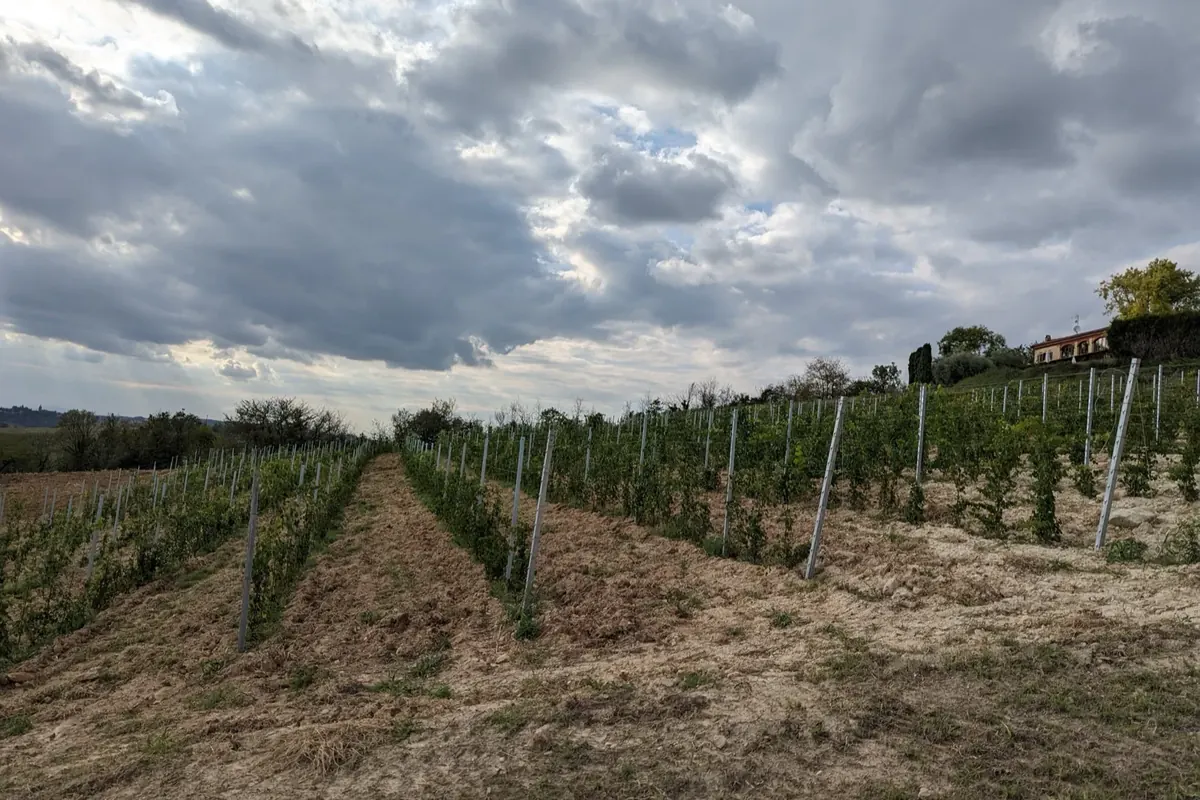
There is a widespread assumption that organic farming and digital technology sit on opposite sides. On one side the traditional vineyard, the experienced eye, the decision taken by smelling the soil and reading the leaves. On the other, sensors, algorithms, screens full of data. For us the two are not in conflict: we use the XFarm platform precisely because it makes our organic work better.
Here is how, in practice.
What XFarm is
XFarm is an Italian precision agriculture platform founded in Trentino in 2017, now used by thousands of farms across Europe. It brings together, in a single environment, data from field sensors, high-resolution weather forecasts, predictive models for the main vine diseases (downy mildew, powdery mildew, botrytis) and tools for managing the farm journal.
It is not an automation system: it does not irrigate for us, it does not decide when to treat. It is an information tool, it tells us what is happening in the vineyard in real time and helps us interpret what we observe during field visits. The final decision always remains ours.
Sensors in the vineyard
At several points across our vineyards we have installed monitoring stations connected to the XFarm platform. Each station reads air temperature and humidity, leaf wetness, soil temperature and moisture at multiple depths, and solar radiation. Data are transmitted hourly and accessible in real time from any device.
Leaf wetness is the most critical parameter for managing fungal disease. Downy mildew and powdery mildew develop under prolonged leaf wetness: knowing exactly how many hours the leaves stayed damp, and at what temperature, lets us calibrate our copper and sulphur treatments (the only ones permitted under organic rules) at the right moment, neither too early nor too late. The result is using less, more effectively.
Soil temperature at 10 and 30 cm depth tells us when root activity is resuming after winter and when the soil is warm enough to work with machinery without damaging its structure. In traditional viticulture this is estimated visually; with sensors we measure it.
Weather data and predictive models
Standard weather forecasts are not precise enough for managing an organic vineyard. What matters is not the forecast temperature at the Asti weather station, but what will actually be recorded in our specific parcel (in that valley, at that altitude. XFarm provides local-scale forecasts) roughly one square kilometre, which it integrates with data from our own stations.
The predictive models for downy and powdery mildew calculate daily infection risk based on the combination of temperature, humidity and vine phenological stage. When risk exceeds a set threshold, we receive an alert. This does not mean we treat automatically: it means we walk the rows with heightened attention.
Organic farming requires more precise timing than conventional growing, because the products available (copper, sulphur, bicarbonate-based preparations) have preventive but not curative efficacy. Acting after infection has taken hold is too late. The predictive models give us the correct intervention window: before the fungus establishes itself, but not before it is necessary.
Soil monitoring and cultivation decisions
Soil health is the first priority of an organic vineyard. Compacted, oxygen-starved or organically depleted soil cannot be repaired in a single season: damage accumulates over years. XFarm helps us track soil condition over time, correlating sensor data with cultivation operations, rainfall and periodic chemical-physical analyses.
A practical example: knowing that the soil at 30 cm has reached a certain moisture level after rain tells us when it is the right moment to run the mulcher over the cover crops, without risking compaction of the deeper layers under machinery weight. It sounds like a minor detail; for soil biology it is not.
Technology serving nature, not replacing it
The real value of XFarm is that it reduces decisions made out of habit or excessive caution. In conventional viticulture there is a tendency to treat "just in case", because the cost of one extra treatment is low. In organic farming that cost barely exists, but the risk of under-treating is real. Technology gives us the data to decide in an informed way: not more often than necessary, not less often than prudent.
A sensor does not replace the experience of someone who walks the vines every day. It replaces doubt, or at least part of it, with a measurement. What you then do with that measurement is still a question of knowledge, of respect for the vineyard and the natural processes that govern it. They are the same choices as always, made with better information.
Keep reading
This article is part of the Organic Farming cluster at Tenuta Magrini. Discover how the biodiversity of the surrounding woodland contributes to vineyard health in the article on vineyard biodiversity, or explore the wines produced with this approach.