
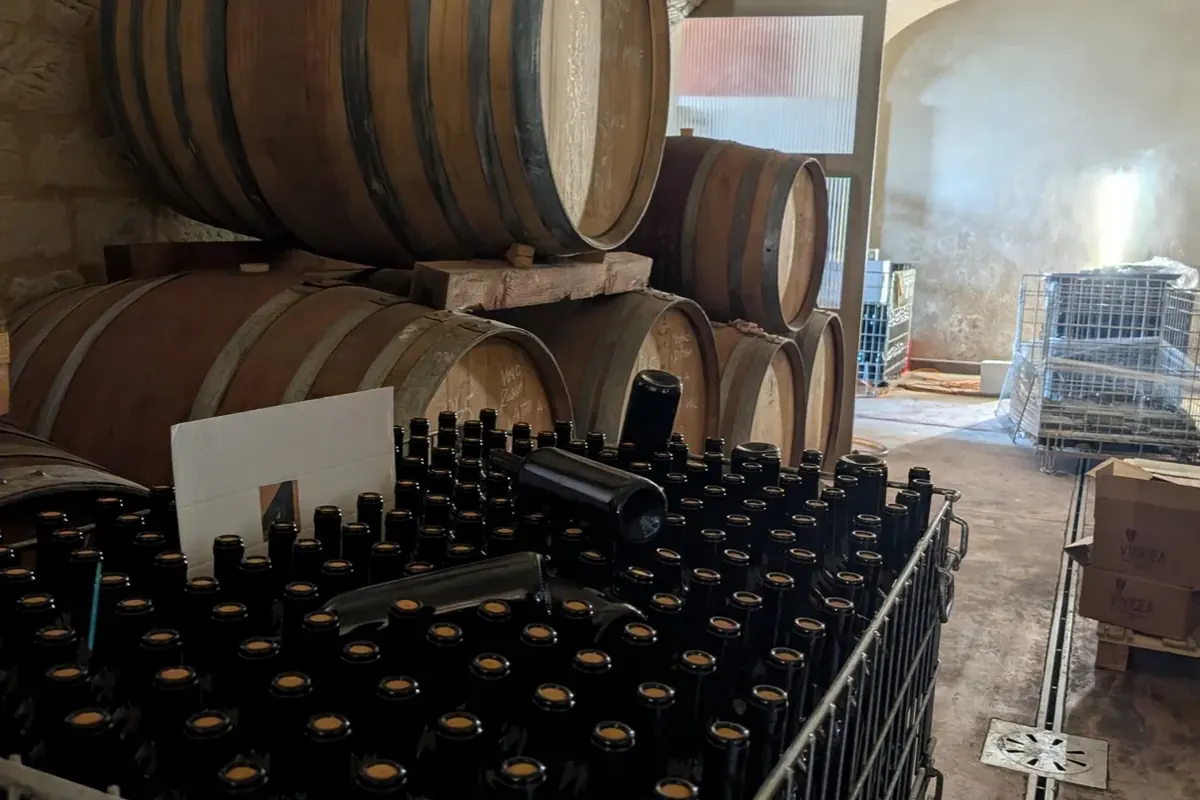
Every vineyard has its own microbial flora. Bacteria, moulds, yeasts, an invisible ecosystem living on grape skins, in the soil, in the air of the cellar. These yeasts, born and grown in a specific place, are called indigenous yeasts. They are what ferments our wine. We use nothing else.
Before explaining why this choice seems to us the only sensible one, it is worth understanding what yeasts are in general, and what distinguishes indigenous ones from those found in the catalogues of industrial wineries.
What yeasts are and what they do in wine
Yeasts are unicellular microorganisms. In winemaking, their job is alcoholic fermentation: they convert the sugars in the must into ethyl alcohol and carbon dioxide. This is not a neutral process. During fermentation, yeasts produce hundreds of secondary compounds (esters, acids, higher alcohols, glycerol) that determine much of the aroma and structure of the finished wine.
Not all yeasts do this in the same way. Different species produce different aromatic profiles. Different populations of the same species, grown in different environments, behave differently. This is where the distinction between selected yeasts and indigenous yeasts becomes fundamental.
Selected yeasts: efficiency in place of identity
Selected yeasts are strains isolated in a laboratory and multiplied on an industrial scale. They are sold in packets or liquid form, with declared characteristics: "fruit enhancer", "good alcohol tolerance", "fast fermentation at low temperature". Each strain has been chosen and stabilised to deliver predictable results.
The advantage is obvious: fermentation starts within hours, proceeds rapidly and under control, and the risk of stuck fermentations or off-flavours is greatly reduced. For a winery that needs to handle large volumes and guarantee a consistent product year after year, selected yeasts are a rational solution.
The problem is that the strain used in Monferrato is the same one used in Burgundy, in Rioja, in Napa Valley. The wine that results carries the yeast's imprint, not the place's. Two wines made from the same grape variety, on different soils and in different climates, will end up resembling each other far more than they should, because the microorganism that transformed them was identical.
Where indigenous yeasts live
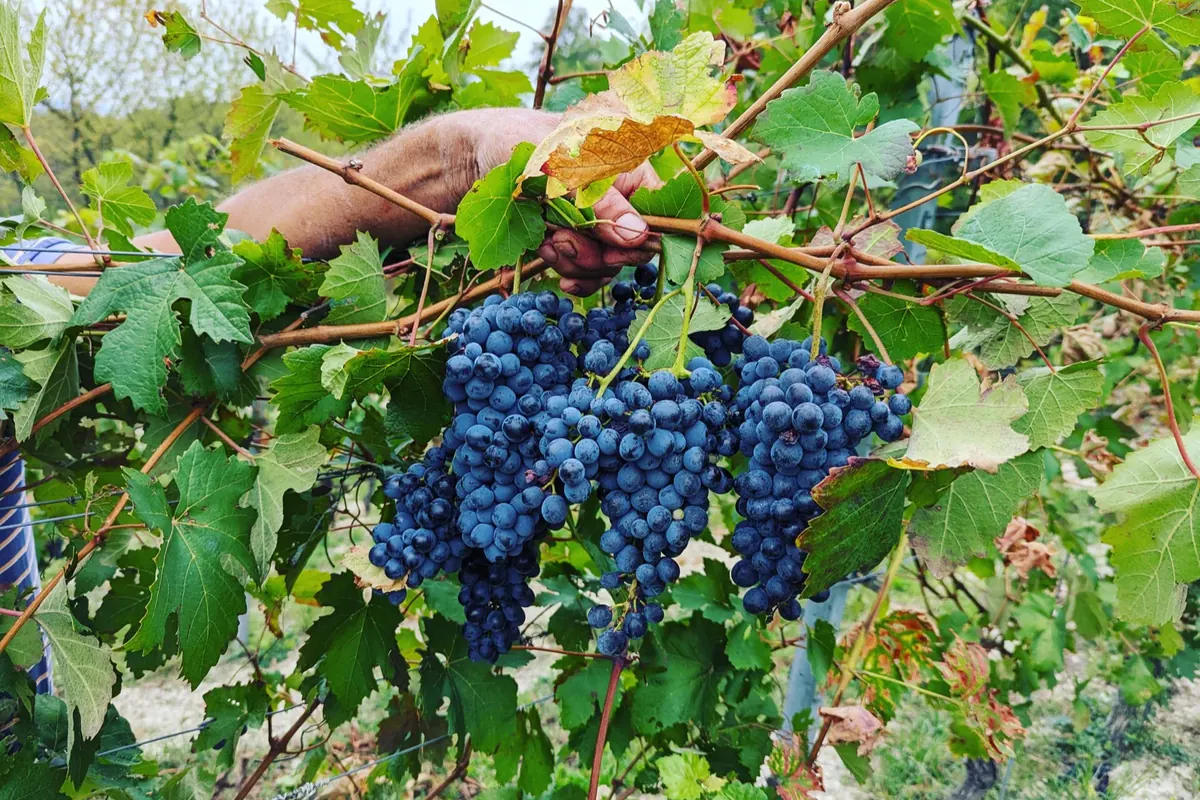
Indigenous yeasts, also called wild yeasts or natural yeasts, are found mainly in three places: on the skins of ripe grapes, in the vineyard soil, and on the walls of the cellar. This last point is often underestimated.
Wineries that have worked with indigenous yeasts for years develop their own stable flora. Yeasts settle into beams, cracks, and vessels: each harvest encounters them, enriches them, transforms them. A new winery, or one that has used selected yeasts and aggressive sanitising treatments for years, has a much poorer flora. Changing approach takes time, years, sometimes a decade.
At Tenuta Magrini we have built this flora by working with the yeasts of our hills from the very beginning. Each vintage has enriched the environment. The yeasts fermenting our wine today are the descendants of those that fermented it in the earliest vintages.
Terroir and yeasts: the invisible bond
The concept of terroir includes soil, climate, microclimate, variety, everything that makes one place different from another. But microbial flora is a component of terroir just as much as limestone in the soil or sun exposure.
When indigenous yeasts are used, the wine carries not only the character of the grape and the soil, but also the specific biological signature of that vineyard, that cellar, that year. It is a complexity that cannot be added from outside. Either you build it by working with what the place offers, or it simply is not there.
For this reason all our wines, Giglio Rosa, Millecolli, Madonna dei Monti and Névola, ferment spontaneously with the yeasts of our vineyards. We add nothing from outside. Fermentation starts when the yeasts are ready, not when we are.
The real risks of spontaneous fermentation
It would be dishonest not to say it: fermentation with indigenous yeasts is riskier than with selected yeasts. The main problems are two.
The first is delayed start. Indigenous yeasts are not pure: the early stages of fermentation involve populations of non-Saccharomyces yeasts that work slowly and produce compounds that, at low concentrations, add complexity, but at high concentrations can become faults. Managing temperature and oxygen during this phase is critical.
The second risk is stuck fermentation. If ambient conditions shift too rapidly, or if the yeast population is not robust enough, fermentation stalls before all sugars have been converted. A wine with unwanted residual sugar is an unstable wine. Managing this risk requires constant attention, experience, and a willingness to intervene without distorting the process.
After years of working with our vineyards' yeasts, we know their behaviour. We know that fermentation starts slowly, goes through a turbulent phase around day five or six, and completes over two to three weeks. It is not an absolute certainty (every vintage is different), but it is knowledge that has accumulated, harvest after harvest.
Why we will never use selected yeasts
The simple answer: because it would change the wine. Not for better, not for worse, into a different wine. A wine with an imprint that is not ours, built in a laboratory instead of in our hills.
The deeper answer: because the work we do in the vineyard (organic farming, hand harvesting, field selection) only makes sense if we follow the same logic in the cellar. Bringing grapes from our vineyards and then entrusting them to an industrial yeast would be a contradiction. We could not look in the eye someone opening one of our bottles and say that the wine truly tells the story of these hills.
Indigenous yeasts are the continuity between vineyard and glass. They are why Millecolli cannot be remade elsewhere. That is not a commercial position: it is biology.