01
Hand-harvesting: why we do it this way
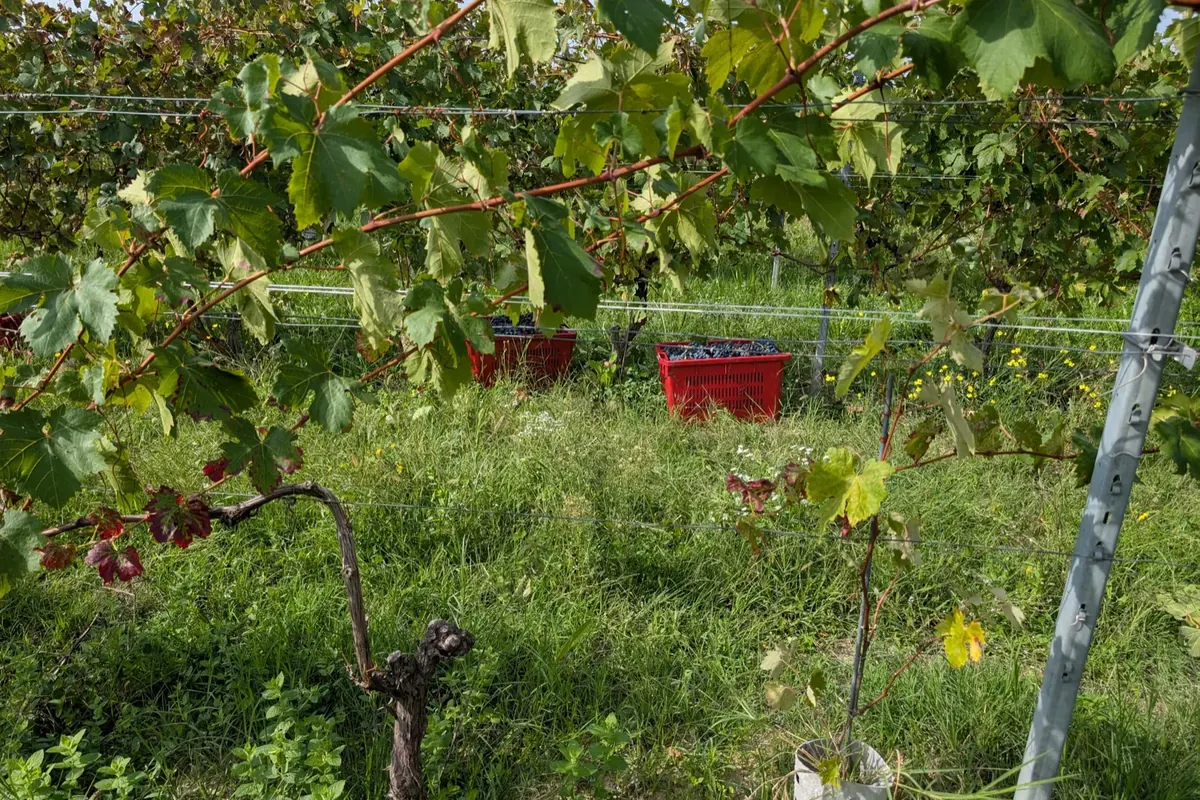
We pick every single bunch by hand, in twenty-kilo crates. Not for romanticism: it is the only way to select fruit, protect the intact berry and bring healthy grapes into the cellar.
Read →
In the Cellar · Topic Cluster
We intervene little. We wait a great deal.
In the cellar, we are guests. The vineyard has already done the hard work (accumulated sugars, acids, aromas), and our job is not to ruin what it brings us. That is why at Tenuta Magrini the cellar protocol is built on absence more than presence: no added yeasts, no acidity corrections, no heavy filtration.
Fermentation starts on its own, when the indigenous yeasts living on the grape skins and in the winery walls decide the time has come. It may take a few days longer than a selected commercial yeast would. That is fine. In that slow time, the complexity you later sense in the glass is being built.
Each wine follows its own path: Giglio Rosa and Millecolli remain in steel to preserve the fruit and the live acidity of Barbera; Madonna dei Monti goes into barrique for eighteen months, where the oak lends oxygen without speaking too loudly. The common denominator is time, we never force it.
In these pages we describe every step: from the hand-harvest that sets everything in motion, to the yeasts you cannot see but can taste, through to the ageing that turns a young wine into something worth the wait.
Cluster articles
We pick every single bunch by hand, in twenty-kilo crates. Not for romanticism: it is the only way to select fruit, protect the intact berry and bring healthy grapes into the cellar.
Read →They are the microorganisms that live on the grape skin and in the winery environment. We do not add them, we wait for them. The difference in the glass is real.
Read →Madonna dei Monti spends eighteen months in second- and third-fill barriques. How it works, why that size, and what changes compared to steel.
Read →A complete map, harvest, destemming, fermentation, ageing, bottling. Every phase explained without technical jargon.
Read →September 2024, day by day. The decisions made, the weather surprises, the moments of waiting and the moments of action. A vintage told from the inside.
Read →The process at a glance
September, at dawn. Every bunch picked by hand into twenty-kilo crates, selected in the field. No mechanical crushing of the berries.
Bunches arrive in the cellar whole. Gentle destemming, a second hand-selection. Only what is worthy goes into the tank.
No added yeasts. Fermentation begins when the indigenous yeasts are ready. It may take days or weeks. It is never rushed.
Giglio Rosa and Millecolli age in steel to preserve fruit and acidity. Madonna dei Monti goes into barrique for eighteen months.
Lightweight bottle, recyclable Nomacorc Green closure. The wine leaves when it is ready, not when the calendar says so.
Frequently asked questions
Hand-harvesting lets us select bunch by bunch, rejecting anything damaged or underripe. Mechanical harvesters break the berries before their time and cannot distinguish healthy from unhealthy fruit. For winemakers who want to ferment with their own indigenous yeasts, starting from intact grapes is everything.
Indigenous yeasts are the microorganisms that live naturally on grape skins and in the winery environment. Unlike commercial selected yeasts, they are not added from outside, we start fermentation simply by letting the grapes begin working on their own. The result is a slower, less predictable fermentation, but one capable of transferring the authentic signature of the place into the wine.
Madonna dei Monti ages for eighteen months in 225-litre barriques, followed by a further period of bottle ageing before release. We use second- and third-fill barrels so the oak contributes oxygen without overpowering the Barbera fruit.
We work to minimise added sulphites. Starting from healthy grapes, fermenting spontaneously and ageing carefully, we manage to keep levels very low. Exact amounts vary by label and vintage, but our guiding principle is: the less you add, the more the wine speaks for itself.
Not yet: we are still setting up to welcome people, so the cellar is not open to visitors for now. Write to us from the contact page anyway and we will let you know when we are ready.
Our wines
Four labels from one single hill. Three Barbera and one Nebbiolo. Every bottle is the story of a vineyard, a vintage, a process that cannot be shortened.
Available at the cellar door by appointment and online at Callmewine.