Every harvest tells a different story. This is 2024: a summer that kept us on edge, a September that handed us back our composure, and a must that looked promising from its first night in the cellar.
The summer that would not let go
June and July 2024 were warm but not brutal. The vines had held enough water from the wetter months before and were showing vigour, perhaps too much: in several rows the canopy grew dense and almost aggressive, and we had to leaf-strip more heavily than usual to keep air circulating around the clusters. Tedious summer work, but necessary.
The real concern came in August. Two weeks without rain, afternoon temperatures climbing past 35 degrees, and a few signs of water stress in the younger vines. Not a dramatic drought (our older vines, with roots driving deep into the Monferrato's layered marly clay, hold up well), but enough to keep us watchful. We were checking the clusters every morning the way you check a patient recovering from something uncertain.
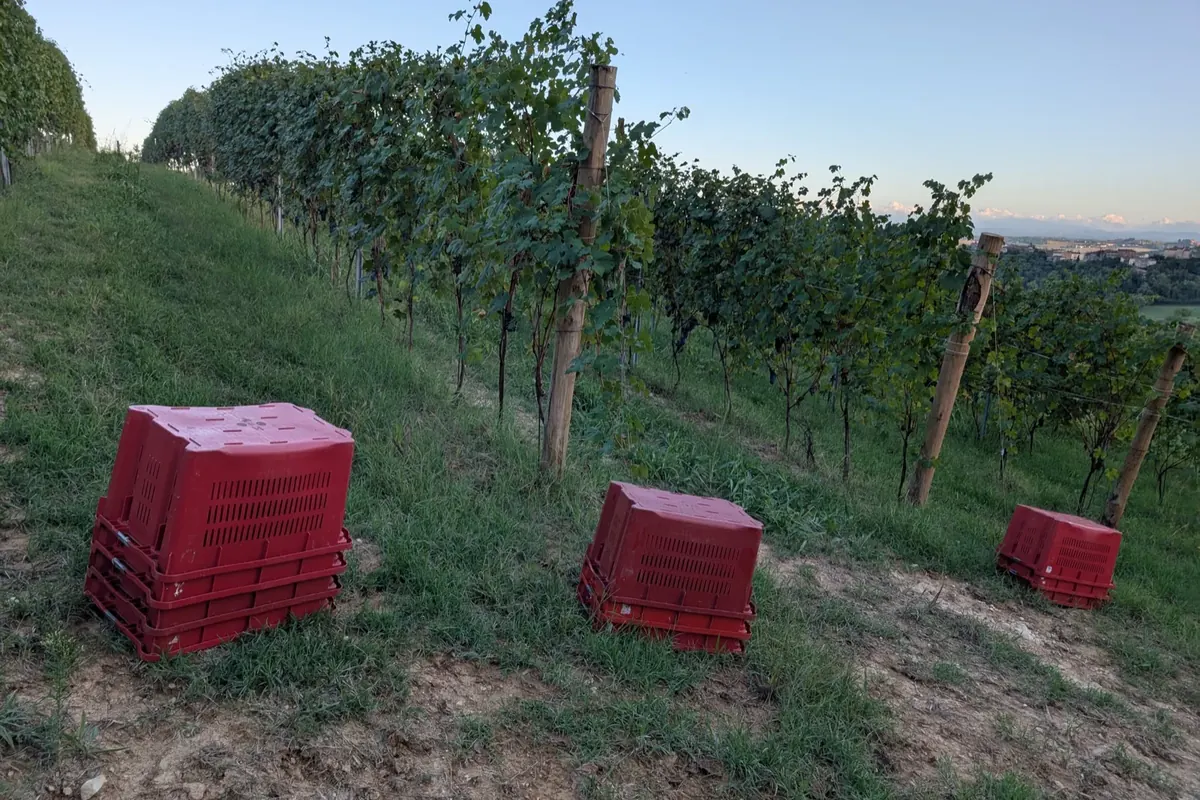
By mid-August, a row near the top of the hill (the one facing south-west, in full sun all day) had already started to change colour. In another vintage that would have been alarming: it means sugar is already climbing and the acidity might not hold. We waited. Waiting was the right call.
September changes everything
On 2 September the rain came. Not a great deal, fifteen millimetres over two days, but enough to break the tension. Then almost overnight the nights turned cool: eighteen degrees at three in the morning, a twelve-degree swing from the afternoon high. For Barbera, conditions close to ideal.
Diurnal temperature variation does two important things: it slows the loss of acidity through the night and encourages aromatic development. When the nights cool down, the grape breathes differently. You feel it later in the must: more fragrant, more taut, with that streak of freshness you spend the August heat worrying you will not find.
We spent the first week of September tasting methodically, row by row. Acidity was holding well, a good sign. Sugars were high, around 22–23 Brix in almost every row, but the balance seemed to be there. The risk of a Barbera that was alcoholically flat, tired, without energy, was receding.
The harvest
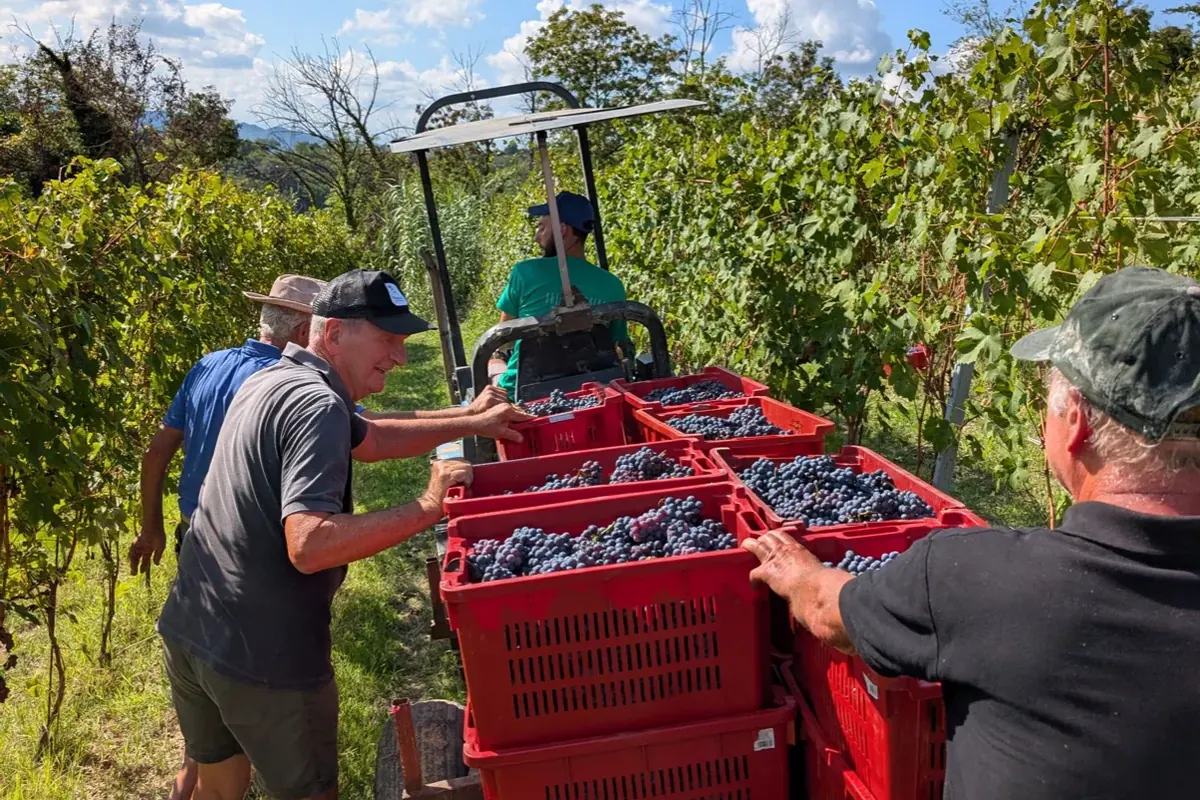
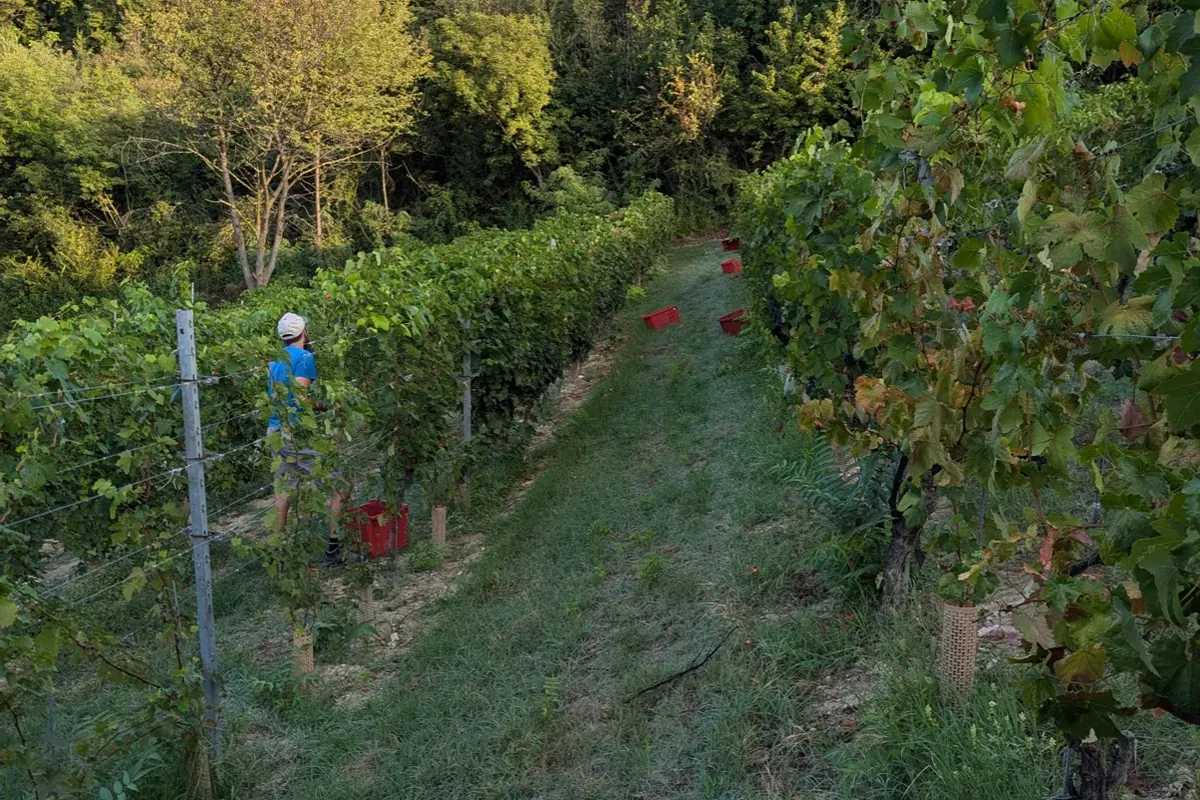
We started picking on 9 September, from the top of the hill downward. The higher-altitude vines, which ripen first because of their aspect, were ready. We began at six in the morning while it was still dark and the grass was wet with dew. Four people on the rows for Giglio Rosa, fruit picked in the coolest hours to preserve the freshness that matters in a rosé.
We came back for the Millecolli and Madonna dei Monti grapes over the following days, finishing on 14 September. The oldest vines, those with feet in the marl that splits into thin plates, gave smaller clusters than usual, with more concentrated berries. Less water, more substance. That is not always an advantage, but this year it was.
Not a single cluster showed botrytis: the August dryness had, paradoxically, kept fungal disease at bay. The crates arrived at the cellar clean.
First impressions from the must
The spontaneous fermentation on the Giglio Rosa started slowly, as it always does. Three days of waiting, then a barely visible tremor on the surface of the must, the indigenous yeasts waking up. The colour in the tank was already beautiful: a deep, almost orange-tinged pink that would clarify toward peach as fermentation progressed.
The Millecolli must had a smell of plum and blackberry that was hard to miss even just walking through the cellar. It does not always happen like that: there are vintages where you have to put your nose right in to find something. Not this one. An encouraging sign.
For the Madonna dei Monti, patience is required: we will not know anything definitive for another eighteen months, when it comes out of the barrique. But even in the first weeks of maceration, the colour was dense, almost opaque, and the acidity on first taste lit up the mouth in exactly the right way.
What we expect
We do not usually make predictions out loud. The wine in the cellar can still surprise you, in either direction, and humility in the face of what you cannot control is part of this work. But this time, in mid-October, with fermentations under way and the cellar smelling the way it should, we will say one thing: the 2024 vintage could be an exceptional one for Tenuta Magrini.
Giglio Rosa will be out in spring 2025: fresh, fragrant, with that acidic backbone the Barbera gives when the vintage allows it. Millecolli a few months later. Madonna dei Monti will have to wait, as always, but everything about the start of this vintage points in the right direction.
For now, we wait. And we keep tasting.