
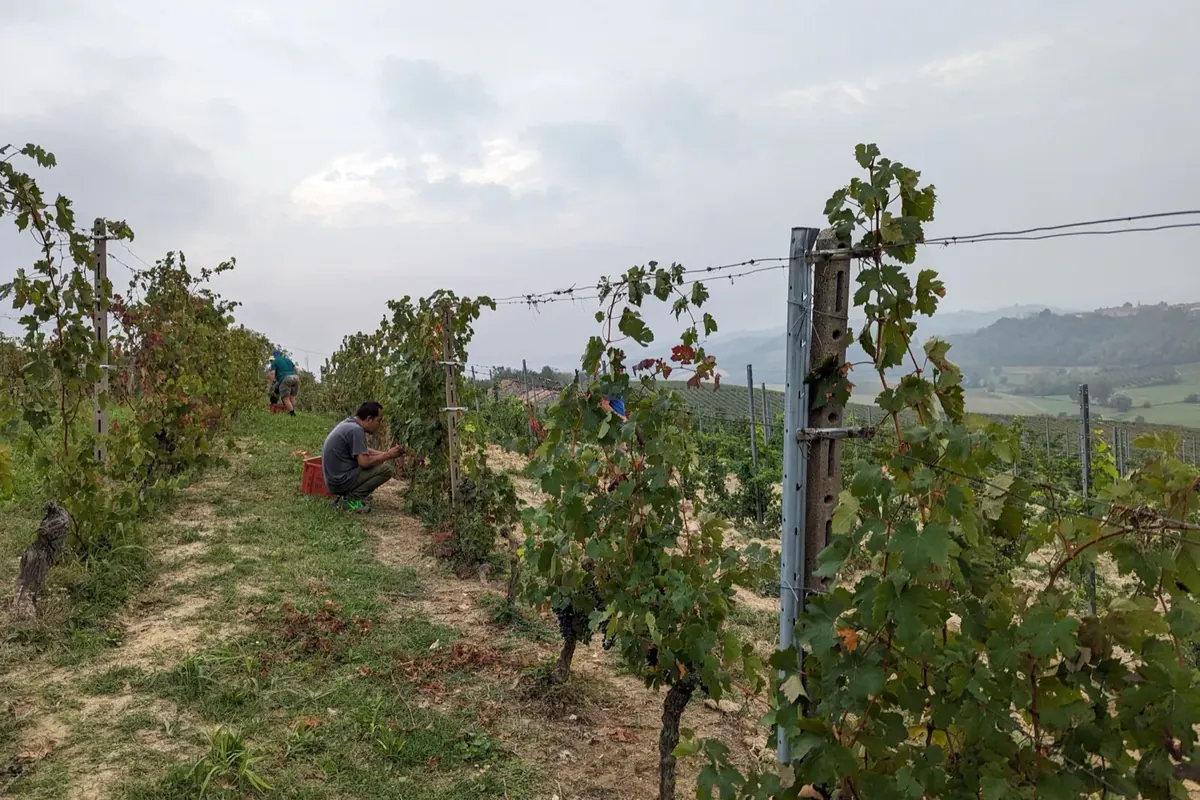
At Tenuta Magrini, harvest is done by hand. Every year, when the grapes are ready, we go into the vineyard with secateurs and twenty-kilogram crates, picking bunch by bunch. It is the choice that allows us to make the wine we want.
The harvesting machine does not discriminate. It takes everything it finds (ripe grapes, unripe ones, diseased ones, leaves, stems), and sends them all to the cellar. In the vineyard, an experienced eye makes the difference no sensor has yet managed to replicate.
What really changes compared to machine harvesting
A mechanical harvester works by percussion: it shakes the vine row and the berries fall onto a conveyor belt. The problem is that this process breaks many berries before they even reach the cellar. Juice escapes, comes into contact with air and solid grape matter, and oxidation begins immediately. In a wine with very little added sulphur, this is a real risk.
Hand harvesting allows the bunch to be collected whole. The skins remain intact until the moment of pressing. The juice does not oxidise in the field. The indigenous yeasts living on the skins, the ones that will drive the spontaneous fermentation, arrive in the cellar alive and in good health.
Then there is the terrain. The hills of Monferrato are not flatlands: our vineyards grow on slopes where a heavy machine would be dangerous, or simply impossible, to operate. The shape of the land has already decided for us, and we are glad it did.
Small crates: not a detail
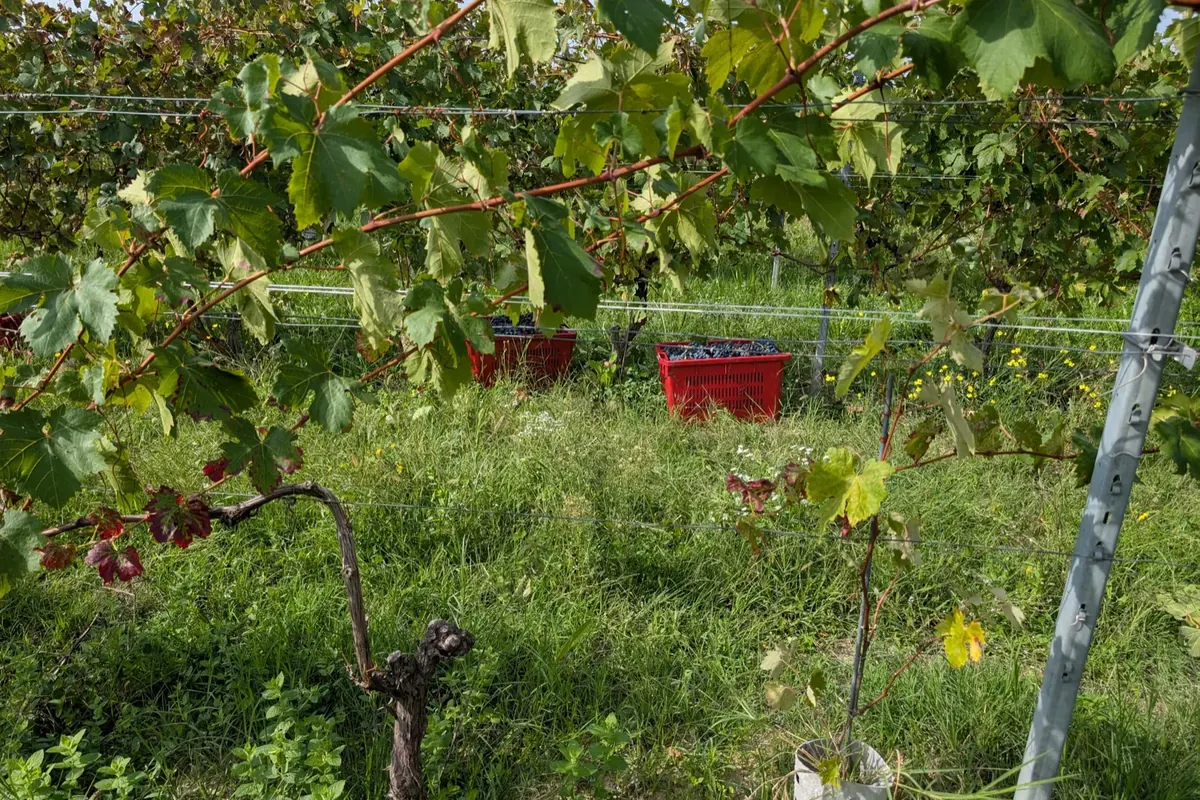
We use perforated crates of twenty kilograms at most. With larger crates, the weight of the top bunches crushes those below and juice begins to leak before the grapes even reach the cellar. Twenty kilograms is the limit beyond which the fruit does not arrive intact.
Small crates mean more slowness, more labour, higher costs. But they also mean that the grapes arriving in the cellar are in the same condition they were in the vineyard. From that starting point, clean choices follow.
Field selection
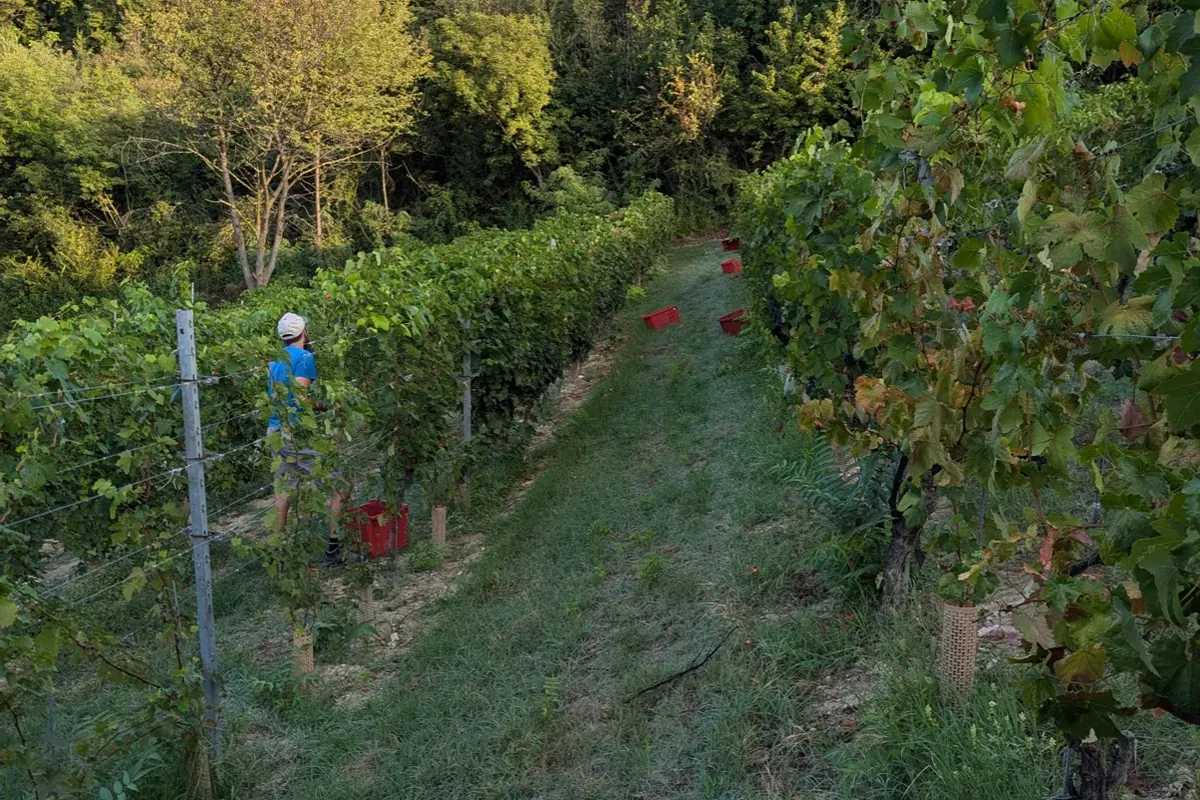
Picking by hand makes one thing possible that a machine cannot do: selection. The people working in the vineyard with us keep their eyes on the grapes and decide bunch by bunch. A bunch with a few mouldy berries is left behind. One not yet at optimal ripeness is left behind. We pick only what is ready, only what is healthy.
This field selection is the first quality filter. We do not correct in the cellar what we can manage in the vineyard: it would be more complicated, less precise, and would require interventions we prefer to avoid.
When to pick: getting the timing right
The moment of harvest is the most important decision of the year. Picking too early means unripe berries: high acidity, little sugar, green tannins. Too late, and you risk over-ripeness: very high sugars, lost acidity, flattened aromas.
For the Barbera of the Monferrato hills, the ideal moment usually falls between late September and the first half of October, with variations from vintage to vintage. We do not follow a fixed date on the calendar: we follow the grapes. Analytical parameters (sugars, total acidity, pH), but also direct tasting and observation of the seeds, which turn from green to brown when ripeness is complete.
For Madonna dei Monti, our Barbera d'Asti Superiore DOCG, we wait a few days longer than for the other wines: we want fuller ripeness, greater concentration, the structure that will support ageing in barrique. For Giglio Rosa and Millecolli, we pick slightly earlier, when Barbera's natural acidity is still lively.
The paradox of slowness
Hand harvesting is much slower than mechanical harvesting. That is the cost we accept in order to choose bunch by bunch.
It is not possible to produce large quantities when harvesting by hand with small crates. And that is precisely why we do it: the limit on quantity is the condition for quality. We prefer to make fewer bottles, made better. It is an economically questionable choice, but an enologically honest one.
Our wines, from the beginning
All our wines are born from this same care in the vineyard. Madonna dei Monti, aged eighteen months in barrique, requires perfect starting material, you cannot correct in the cellar what was neglected in the field. Millecolli, Giglio Rosa and Névola, aged in stainless steel, express the fruit with fewer filters: every vineyard decision is felt directly in the glass.
Harvesting by hand is the first act of respect towards the grape. Everything else comes after.