
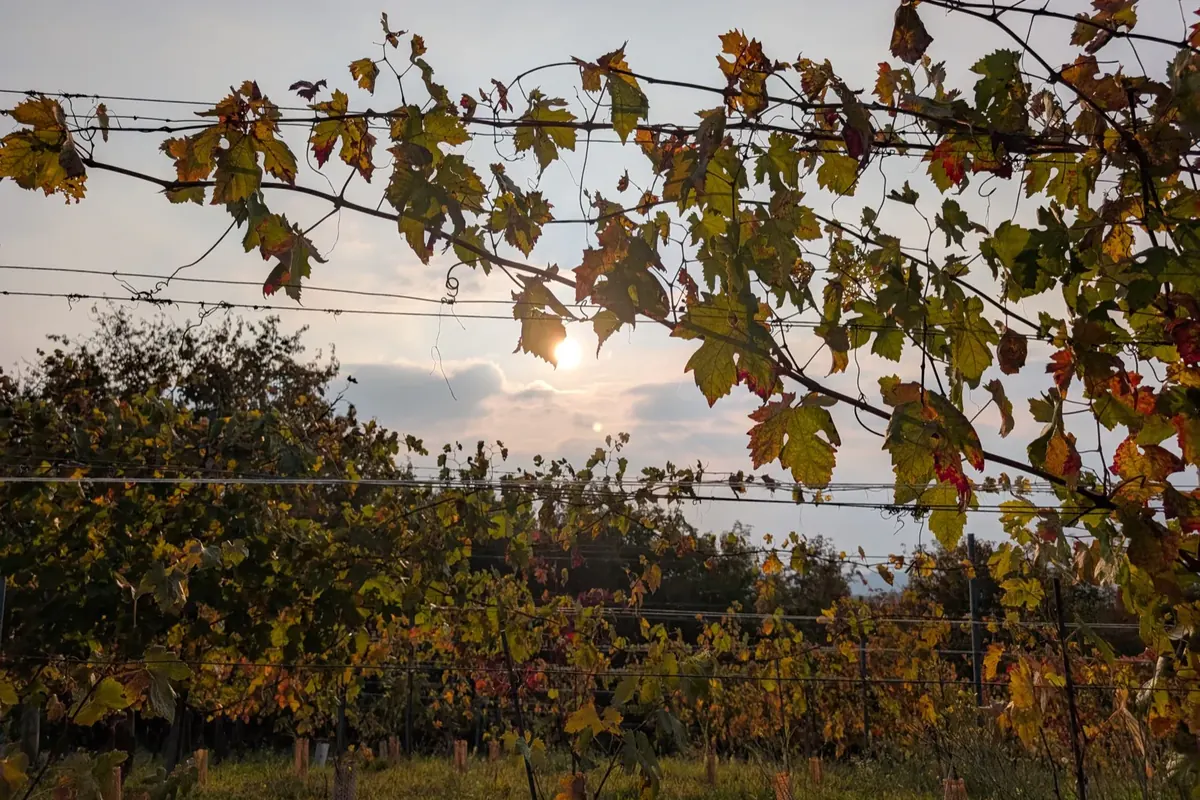
A vineyard never truly sleeps. Even in December, when the rows stand bare and the wind off the Monferrato hills pushes the low fog up to the ridge, something is moving underground. The roots of the Barbera press deep into the blue marl of Grazzano Badoglio, drawing in minerals, storing energy for the next cycle. The grower knows that what is done in winter determines what will be harvested in autumn.
Here at Tenuta Magrini we work just over three hectares on a south-facing slope at 350 metres above sea level. Barbera in three expressions (Giglio Rosa, Millecolli, Madonna dei Monti) all born from the same landscape, the same soil, the same annual cycle. This is that cycle, month by month.
Winter: silence and secateurs (December – February)
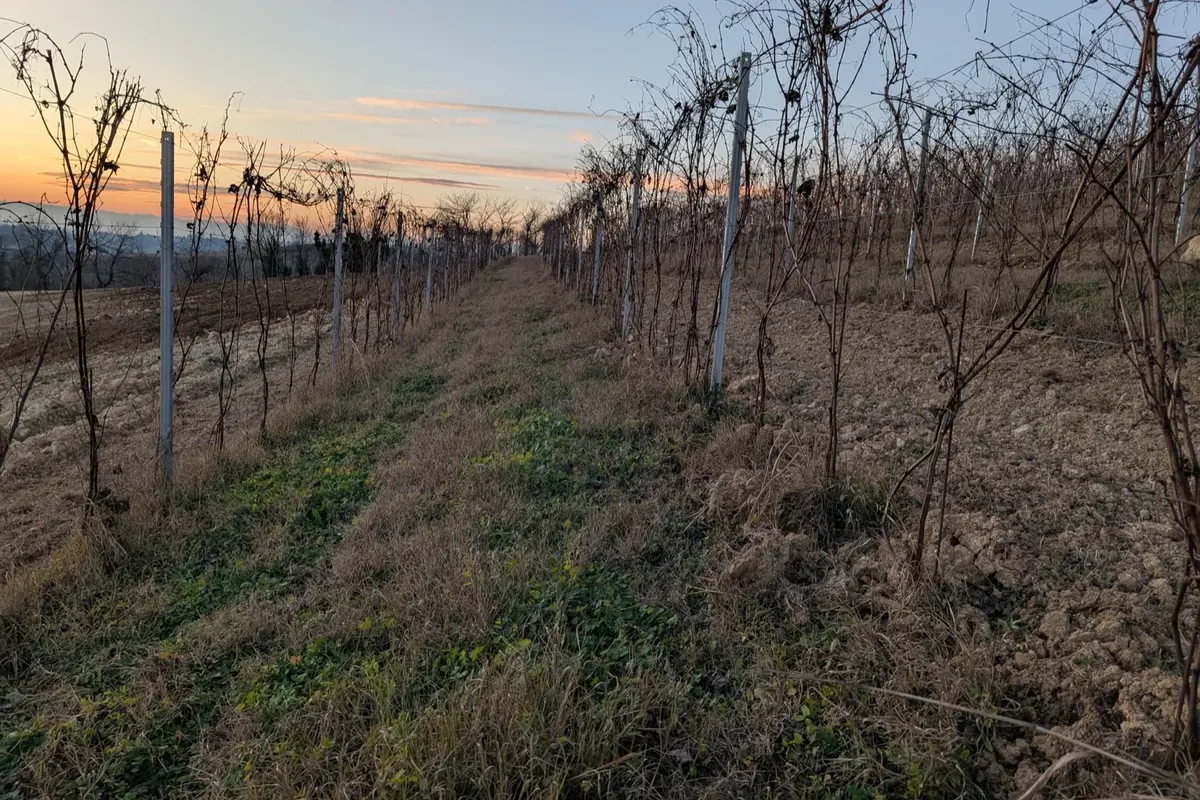
December in the vineyard has the feel of an ending. The leaves have fallen, the wood is bare, and the rows seem pencilled against a grey sky. But this is exactly when the most important work of the year begins: pruning.
In January and February we prune to Guyot, the training system we use for the Barbera on these soils. You choose the year's cane, cut back the old wood, leave the minimum number of buds necessary. Each cut is a decision that will shape production for the whole of that year: too long and the vine disperses its energy into excessive growth, too short and you risk stressing it. The work is done by hand, with secateurs, usually on the coldest mornings of the year. Fingers go numb. The pruned canes are collected and chipped back into the soil.
At this time the cellar is quiet. The wines of the previous vintage rest in stainless steel or in barrel, completing their slow evolution. There is time to reflect on what worked and what didn't in the year just closed.
Spring: the awakening (March – May)
The weeping of the vine arrives towards the end of February or the first days of March, when soil temperature climbs above ten degrees: sap begins to seep from the pruning wounds. It is the first sign that the vegetative cycle has restarted.
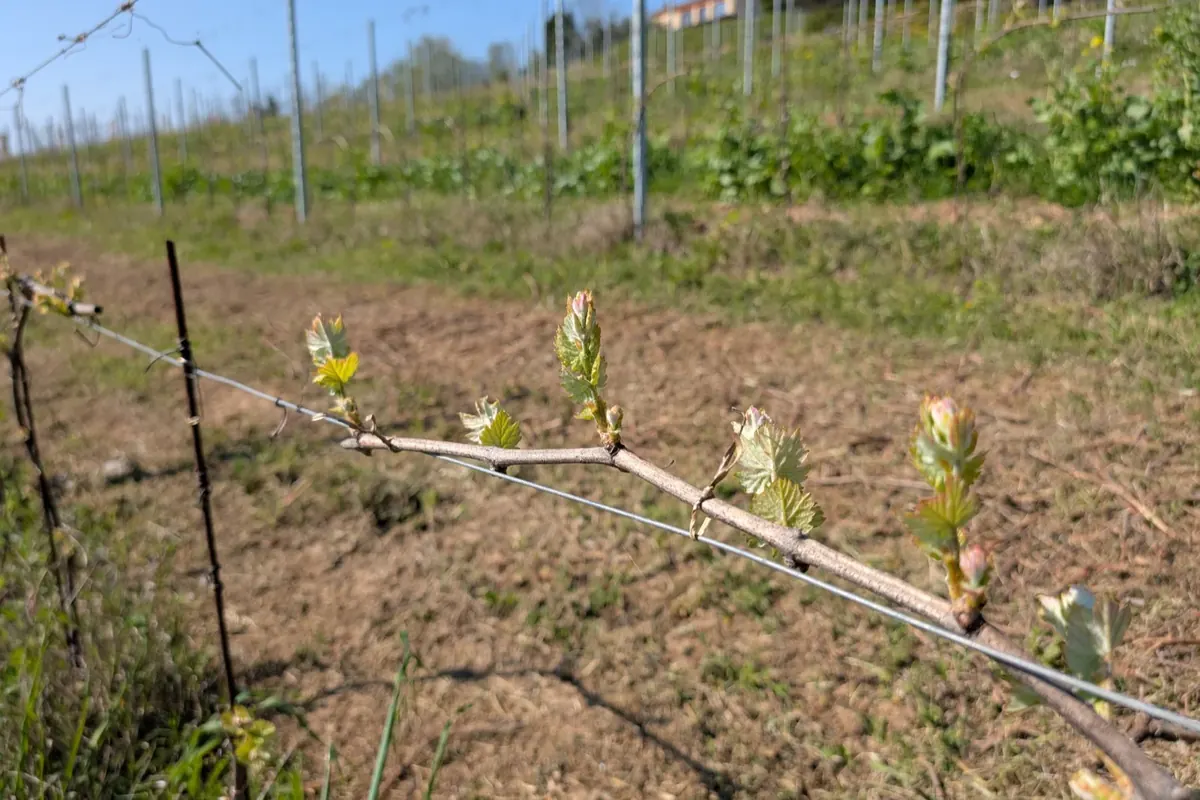
In April, budbreak transforms the rows: from bare wood emerge the first tiny leaves in a brilliant, almost unreal green that bears no resemblance to the dusty green of July. This is the moment of greatest vulnerability: late frosts can destroy the new shoots in a single night. On the ridge at Grazzano the risk is real until mid-April; the southern aspect helps, but offers no guarantee.
By May the vineyard is growing quickly. We begin shoot positioning, tying new growth to the training wires, and leaf removal around the clusters to improve air circulation. The soil between the rows is managed with controlled cover cropping: we do not use herbicides, and never have. The wild grasses compete with the vine for water, but they also protect the topsoil from erosion and support biodiversity.
Summer: green and heat (June – August)
In June the vineyard enters flowering: the clusters form, the berries are still tiny and green. Fruit set, how many of those berries will become mature grapes, depends heavily on the weather during these weeks. A cold, wet June can compromise a significant part of the harvest.
July and August are the months of canopy management. We trim the upright shoots to prevent the vine from dispersing energy in unproductive growth, and we monitor the canopy constantly to ensure sun and air reach the clusters. In an organic vineyard, without synthetic fungicides, defence against downy and powdery mildew requires timely interventions with copper and sulphur at the right moments and in minimum doses. You walk the rows, you look, you decide.
The August heat can be serious on these hills, 35 degrees in the afternoon hours is not unusual, but nights remain cool thanks to the altitude and the wind. This diurnal temperature range is one of the main reasons why Barbera from these hills has an acidity and aromatic freshness that lower sites cannot match.
Autumn: the harvest (September – October)
Véraison usually arrives in mid-August: the berries change colour from green to deep violet and sugar accumulation begins. From that point on, ripeness is tracked daily, individual berries are tasted, sugars and acidity are measured, the weather is watched.
The harvest at Tenuta Magrini is always by hand and into small crates. We do not use mechanical harvesters: Barbera on these clay and sloping soils requires selection that a machine cannot provide. We pick healthy fruit and leave damaged clusters behind. The timing of picking varies from year to year: the grapes for Giglio Rosa are harvested first, still retaining freshness; those for Madonna dei Monti stay on the vine longer, sometimes into October, to reach the full ripeness that the Barbera d'Asti Superiore DOCG requires.
In the cellar the grapes arrive whole, pressed as little as possible. Fermentation starts on its own, driven by the yeasts that live on the grape skins and in the air of the cellar. Nothing is added.
The return to silence (November – December)
After the harvest the vineyard prepares for rest. The leaves yellow, photosynthesis shuts down, and sugars are stored in the roots and old wood as a reserve for the following spring. The rows return to the spare silhouette of winter.
In November comes organic fertilisation, compost and organic matter that feeds the soil without disrupting the microbial balance built through years of organic work. And towards the end of November, into December, pruning begins again. The cycle restarts.
There is something reassuring about this repetition. It is not monotony: every year is different from the last, a warm vintage, a wet one, hail in July, a perfect August. But the rhythm stays the same. And the rhythm is also what ends up in our wines: the memory of a season, which cannot be rebuilt in a cellar.
The wines that come from this cycle
Our labels, all spontaneously fermented. The vineyard work described here is what ends up, literally, in every bottle.
- Giglio Rosa — Still Rosé →
- Millecolli — Barbera d'Asti →
- Madonna dei Monti — Barbera d'Asti Superiore DOCG →
- Névola — Rosé Wine →
Want to see the vineyard in person? Write to us to arrange a visit →