
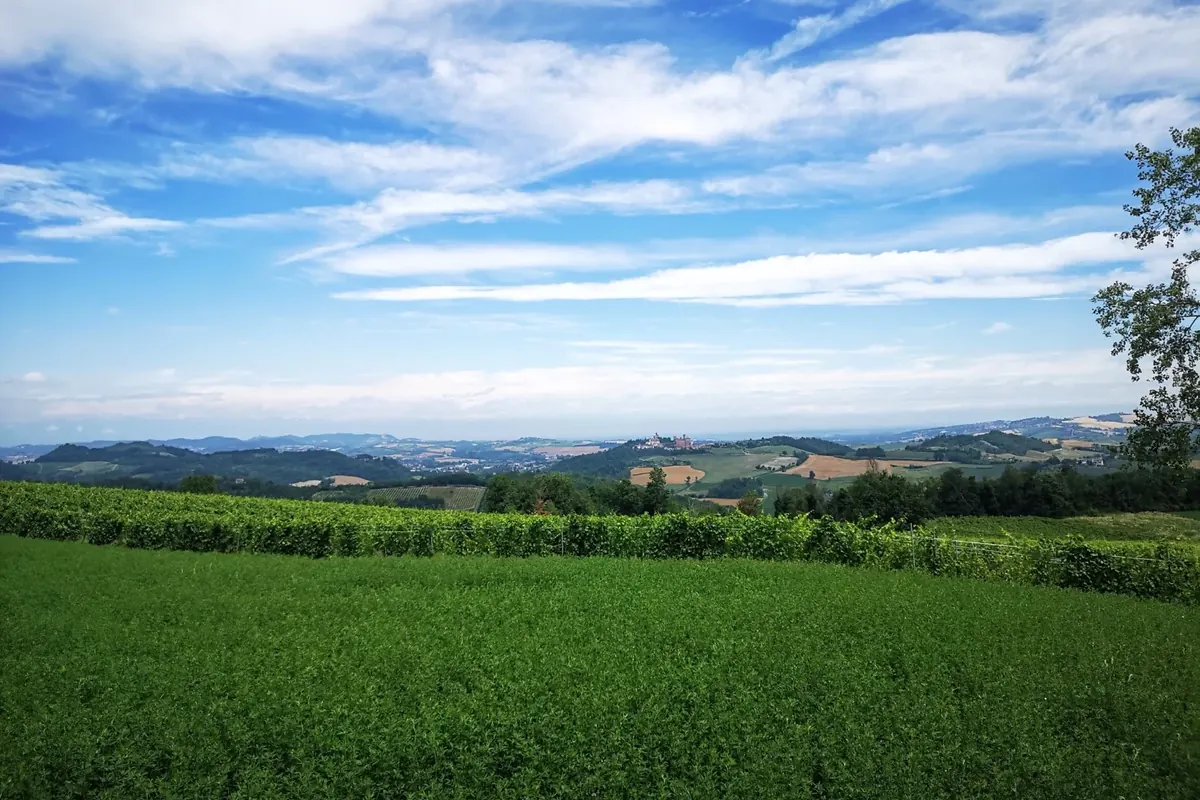
Say Monferrato and most people hear Piedmont. But a few kilometres here are enough to turn the same grape into a different wine: the aspect changes, the soil changes, the hour the sun leaves the row changes. It is on this corner of Piedmont between Asti and Alessandria that we put down roots.
The geography: hills as far as the eye can see
Monferrato spreads across roughly 1,200 square kilometres in the heart of southern Piedmont, nestled between the Po river to the north and the Ligurian Apennines to the south. It is a landscape of hills that never quite reach 500 metres and never stop rolling. To the west lie the Langhe and Roero; to the east, the Casale Monferrato area and the first reaches of the Alessandria province. Each valley has its own aspect and its own wine history.
The Asti Monferrato, where our estate sits, is the warmest and most clay-rich portion, where Barbera finds its most generous and deep expression. The slopes open south and south-west, catching every available hour of sun from April to October. Elevations range between 200 and 400 metres above sea level: high enough to ensure beneficial nocturnal temperature drops, low enough to ripen grapes consistently.
The UNESCO listing
In 2014, UNESCO inscribed the Vineyard Landscape of Piedmont: Langhe-Roero and Monferrato on its World Heritage List. It is not an honorary title: it recognises a landscape built by centuries of viticulture. The terraces, the rows, the villages on the ridgelines are the result of work nobody planned from above.
The listing brings a practical responsibility rather than a rhetorical one: to leave the landscape at least as we found it. For us that means certified organic farming, hand harvesting, and no chemical shortcuts.
The climate: continental, with a door open to the sea
Monferrato's climate is temperate continental, though the label says little. The Alps to the north stop the coldest and wettest winds; the Ligurian Apennines to the south let through warm, dry currents from the sea in summer.
Average summer daytime temperatures range from 20°C to 28°C, with nocturnal drops of 10–15°C that are vital for building varietal aromas. Winters are cold, January frosts can reach −8°C, but rarely destructive. Spring is capricious, with necessary but unpredictable rain. Autumn is the season that counts: weeks of clear sun, dry air, temperatures falling gradually. That is where the harvest is decided.
Annual rainfall averages around 600–700 mm, concentrated mainly in spring and autumn. Summers are moderately dry, which encourages sugar concentration in the grapes and reduces the risk of fungal disease, a critical point for anyone farming organically, as we do.
What reaches the glass
Monferrato's terroir is the sum of all this: the geology (calcareous marls and clays of marine origin), the topography (regular slopes, open aspects), the climate (warm but not scorching, dry but not arid), and Barbera, which was born here.
When you taste one of our wines, whether Millecolli or Madonna dei Monti, this is what you are tasting: November mist, the dry heat of August, soils that came out of an ancient sea. Geology and meteorology, ending up in a glass.
Continue exploring: discover our village, Grazzano Badoglio, and learn more about the specific soils of our estate.