
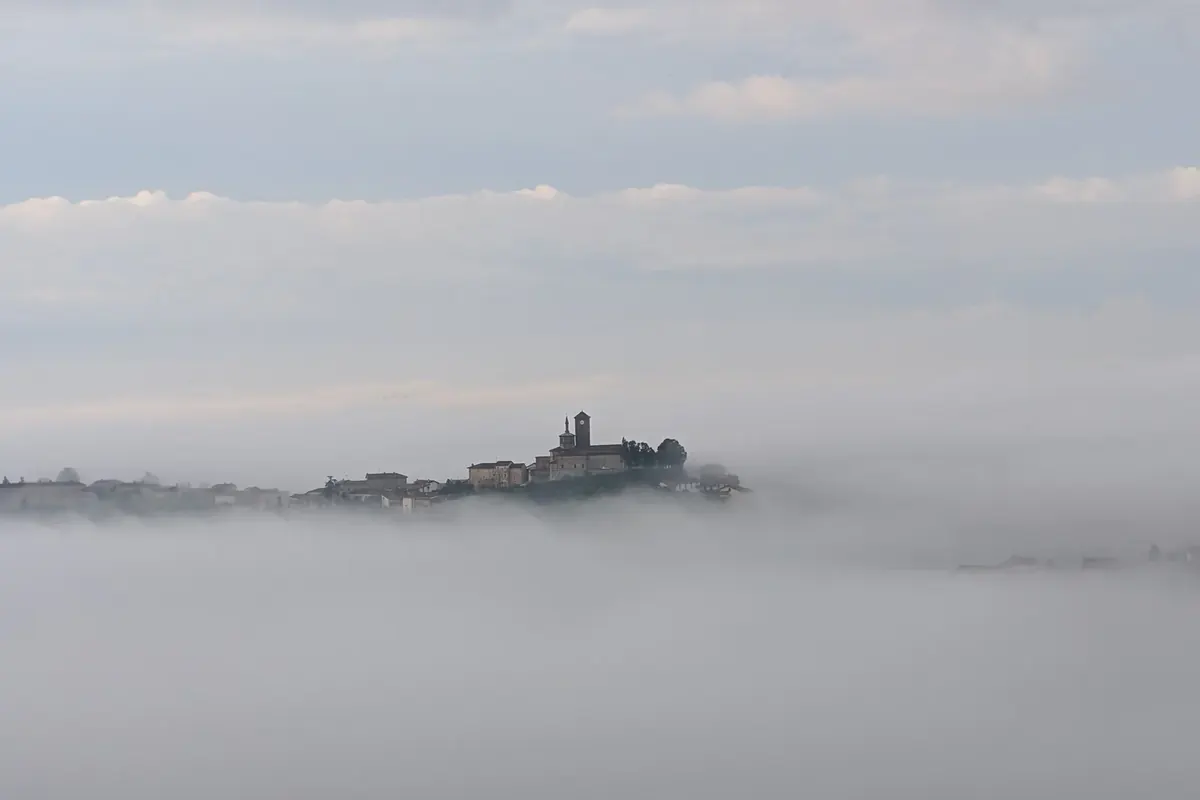
There is only one way to know a place: living in it. Waking to low fog floating between the rows, hearing the church bell mark noon, knowing the name of whoever tends the vineyard on the opposite slope. Grazzano Badoglio, for us, is not a destination. It is home.
A village with its own story
Grazzano Badoglio is a municipality of just over 600 inhabitants in the province of Asti, nestled among the hills of the Asti Monferrato at around 250 metres above sea level. The village has medieval origins, the earliest written records date to the 12th century, and like many Monferrato villages its history is intertwined with local lordships, the conflicts between the Commune of Asti and the Marquesate of Monferrato, and of course with the vine.
The current name, Badoglio, was adopted in 1939 to honour Marshal Pietro Badoglio, born here in 1871 and a controversial figure in twentieth-century Italian history. Before that, the village was simply called Grazzano Monferrato. Under any name, however, it remains a place where time flows to a different rhythm, one tied to the seasons, the harvest, the threshing.
The historic centre retains its compact hilltop village structure: the main square, the parish church dedicated to San Giovanni Battista, narrow lanes that open occasionally onto panoramic views over the surrounding hills. This is not a picture-postcard village: it is a lived-in place, with its shop, its bar and its houses opening onto the street.
Where we are: Tenuta Magrini
Our estate is located at Strada Oliva 5, on the southern slope of the municipality, about a kilometre from the village centre. We sit at 350 metres of altitude, on a south-facing hillside that looks out toward the hills of Casale Monferrato in the distance. Around us: vineyards, hazelnut groves, a few centuries-old oaks, and the particular quiet of this countryside.
We chose this spot for specific reasons. The south-facing aspect lengthens the hours of sun; the elevation of 350 metres guarantees the temperature swings that keep acidity alive in the grapes; the position set back from the plain protects us from the late spring frosts that are often fatal to Barbera buds.
How to get here
From Turin (approx. 55 km · 50 minutes)
- Motorway A21 Turin–Brescia, exit Villanova d'Asti
- SP 35 toward Asti, then SP 10 toward Moncalvo
- From Moncalvo, SP 36 toward Grazzano Badoglio (approx. 8 km)
- Alternative: SS 457 from Turin toward Chivasso, then SP 590 to Asti and SP 10 toward Moncalvo
From Milan (approx. 120 km · 1 h 20 min)
- Motorway A7 Milan–Genoa to Tortona, then A26 toward Alessandria
- Exit Casale Monferrato Sud, SP 35 toward Moncalvo
- From Moncalvo, SP 36 toward Grazzano Badoglio
- At certain times faster: A4 toward Turin, exit Villanova d'Asti
There is no direct train to Grazzano Badoglio, we are in the heart of the Piedmontese countryside, and a car remains the most practical means of transport. The nearest railway station is Moncalvo (Asti–Casale Monferrato line), from where a taxi or hire car can reach the village in about 15 minutes.
The food of Monferrato
Coming all the way to Grazzano Badoglio without stopping to eat would be a waste. The cooking of this corner of Monferrato is short on ingredients and long on flavour: the peasant tradition built a whole repertoire out of a handful of local products, and it needs no defending.
The stars of the local table are Barbera (naturally), white truffles from Asti in the autumn months, hand-made agnolotti del plin, bagna càuda on November evenings, and vitello tonnato at summer Sunday lunches. Within a few minutes of the village you will find trattorie still cooking without pretension, from local ingredients.
Moncalvo, a few minutes' drive away, is known as "Italy's smallest city" and hosts a historic truffle fair each autumn. Asti, 25 km away, has the full range of Piedmontese gastronomy and a medieval centre worth the stop.
The estate is not open to visitors yet, but we are working on it: write to us and we will let you know when we are ready. Learn more about our territory: the climate and terroir of Monferrato and the specific soils of our estate.