
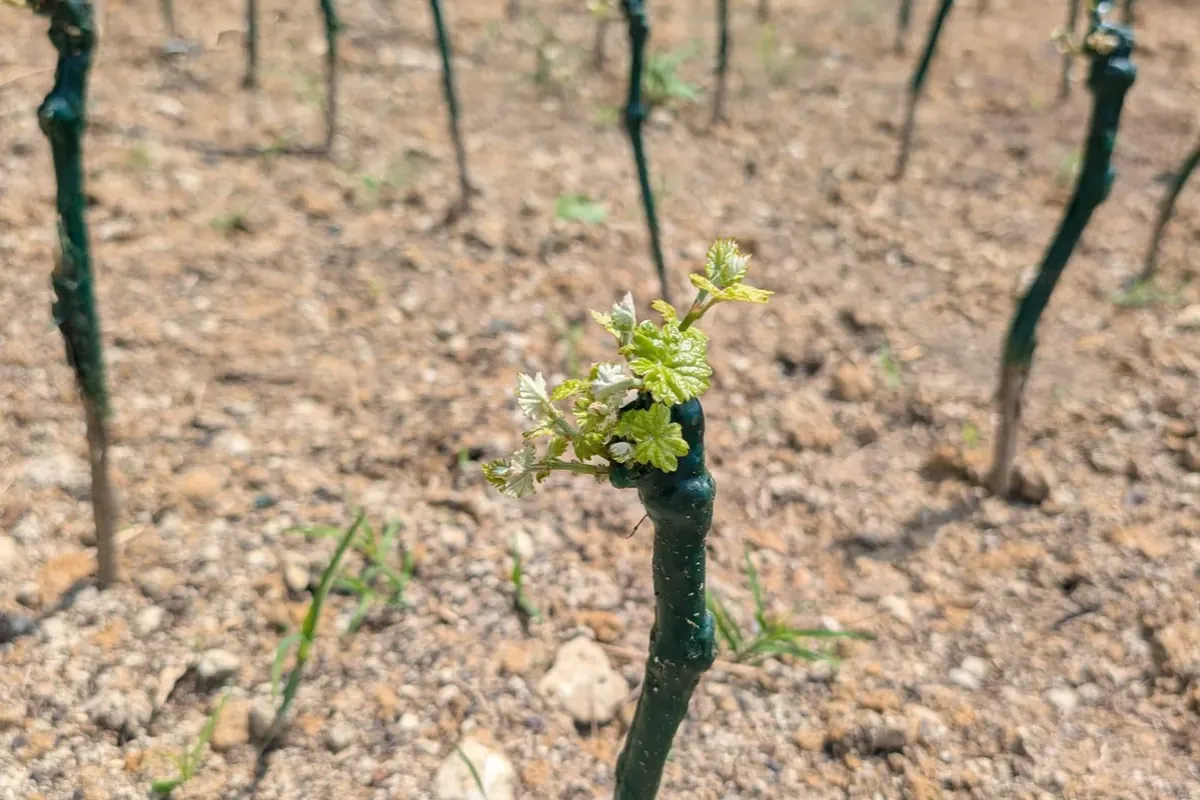
The soil of Asti Monferrato has a consistency of its own: neither the sandy lightness of the Langhe nor the weight of the Po plain. You feel it pushing a hand into the earth between the rows, and you find it again in the glass. Soil is not the substrate the vine happens to grow in: it is the first thing that decides what the wine will be.
The geological history of Monferrato
To understand today's soils, you need to go back a few million years, to the Miocene. The Monferrato we see today was then a seabed, part of the ancient Padano Sea, an inlet of the Mediterranean that covered much of northern Italy. When the waters receded, they left behind vast deposits of sediment: marine sands, clays, silt, and above all marls, a sedimentary rock composed of calcite and clay.
Over the following millennia, tectonic movement and Apennine erosion shaped those former seabeds into a complex hill system, with slopes of varying gradient and composition. The result is a strikingly varied soil mosaic: within a few kilometres you shift from predominantly clay soils to marl-limestone ones, from sub-alkaline to near-neutral reactions, from compact substrates to friable ones. That variety is why two neighbouring vineyards give different wines.
The three fundamental components
| Component | Physical characteristics | Effect on vine and wine |
|---|---|---|
| Marl | Mixed sedimentary rock (clay + calcite), grey-yellowish colour, moderately friable | Moderate drainage, balanced water retention. Encourages minerality and structure. In summer months, keeps root-zone temperatures cooler, preventing excessive water stress. |
| Clay | Fine texture, high water retention capacity, yellow-ochre colour | Manages water like a slow reservoir. Protects the vine during dry years; in Barbera, enhances body and colour depth. Tends to compact, so requires careful soil management. |
| Active limestone | Calcium carbonate in assimilable form, sub-alkaline pH (7.5–8.2) | Governs uptake of iron and other micronutrients. On suitable rootstocks, as we use, active limestone amplifies the natural acid tension typical of Barbera. |
The specific terroir of Tenuta Magrini
Our vineyard sits at 350 metres above sea level on a south-facing slope in the municipality of Grazzano Badoglio. This elevation (at the higher end of the Asti Monferrato average, which typically ranges between 200 and 300 m) makes a measurable difference. Nocturnal temperatures are 2–3°C lower than in the valley floors, which slows ripening and allows the grape's acidity to remain vibrant even in late September, when daytime heat is still intense.
Our soils are predominantly marl-clay, with an active limestone content of around 12–15%, a threshold that demands rootstocks specifically selected for tolerance to iron chlorosis, but which, once that variable is managed, yields wines with a mineral backbone that neutral or acidic soils do not give.
The south-facing aspect is perhaps the single most decisive variable. On a well-exposed slope in Asti Monferrato, solar radiation during September can be 30–40% higher than on a north-facing slope in identical weather conditions. This translates to more complete polyphenolic ripeness, skins richer in anthocyanins and mature tannins, the foundations of the longevity you find in a wine like our Madonna dei Monti.
How the soil reads in the wine
Soil composition leaves recognisable traces in a wine's aromatic and gustatory profile. Marlstone soils tend to produce wines with greater mineral complexity, a faint ferrous or saline note that emerges particularly after a few years of ageing. Clay soils contribute body, sustained colour over time, and the velvety texture typical of Barbera from Asti Monferrato.
Active limestone, finally, is the key driver of Barbera's acid profile: on calcareous soils Barbera keeps an acid tension that carries a whole meal, from starter to cheese, without tiring the palate.
The next time you open a bottle of our Millecolli or Madonna dei Monti, there is an ancient sea in it, millions of years of sediment, and September sun on a south-facing slope. Everything else is our doing, and it is the smaller part.
Continue exploring our territory: the climate and geography of Monferrato, and the village of Grazzano Badoglio.